The Power of “YET” in Feeding Therapy

What Is the Power of “Yet”?
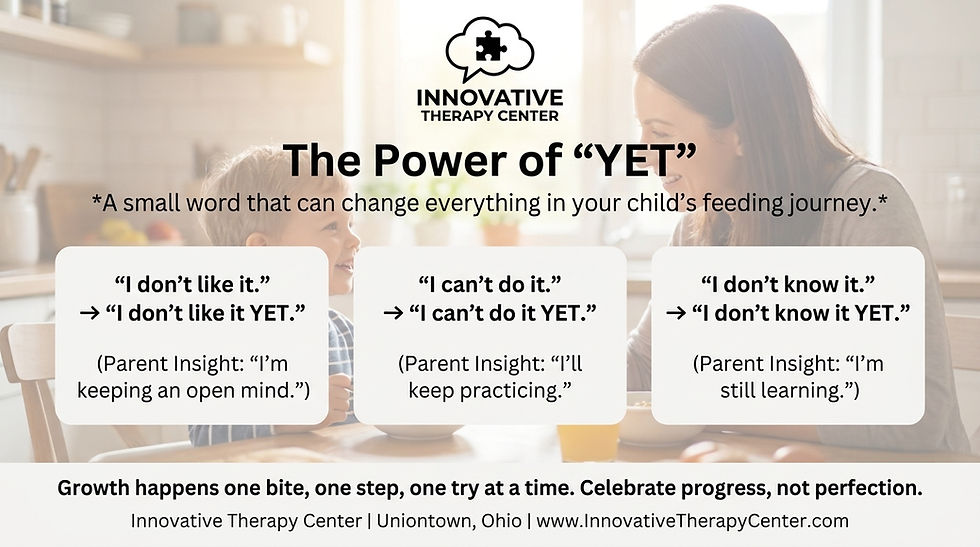
In feeding therapy, progress does not always look like taking a bite of a new food. Sometimes progress is being willing to look at a food, tolerate it on the table, touch it, smell it, or explore it without pressure. The word “yet” can help children and caregivers recognize that a skill is still developing rather than believing it is impossible. Instead of focusing on what a child cannot do, we can reframe the experience around what the child may be able to do with time, practice, support, and repeated positive experiences.
“I Don’t Know It…YET.”
Trying a new food involves more than simply tasting it. Children may need opportunities to learn what a food looks like, smells like, feels like, sounds like, and how it behaves in their mouth. A child might say, “I don't know what that is,” or “I don't know if I like it.” Instead of expecting an immediate bite, we can encourage curiosity: • “You don't know it yet—let's learn about it together.”
• “What do you notice about it?”
• “Is it crunchy, soft, cold, warm, smooth, or bumpy?”
• “You can explore it without having to eat it.”
“I Don’t Like It…YET.”
Taste preferences are learned and can change. A food that is unfamiliar today may become more comfortable after repeated, low-pressure exposure. Importantly, “yet” should not mean that a child must eventually like every food. The goal is to create opportunities for exploration while respecting the child's communication and autonomy. Try reframing:
• “I don't like it yet” instead of “I hate this food.”
• “My taste buds are still learning about it.”
• “I can smell it, touch it, or lick it if I'm ready.”
• “I don't have to eat it today.”
“I Can’t Do This…YET.”
Feeding skills develop over time. A child may not yet be able to chew a particular texture, manage a mixed consistency, use a mature chewing pattern, or tolerate a food near them. Instead of “I can't do this,” we can celebrate the next achievable step: • “I can't chew this yet.”
• “I can't eat this texture yet.”
• “I can't touch it yet.”
• “I can't sit with this food yet.”
• “I'm still learning.”
Why “Yet” Matters in Feeding Therapy
The “power of yet” can help shift the conversation from failure to learning. For children with feeding difficulties, this can reduce all-or-nothing thinking and create room to celebrate small steps. Progress may look like:
• Looking at a new food without distress
• Allowing a food on the plate
• Tolerating a new smell or texture
• Touching, smelling, licking, or interacting with a food
• Taking a tiny taste
• Learning a new chewing or drinking skill
• Expanding food variety over time Every step can provide valuable information and build confidence. The Power of “Yet” for Parents & Caregivers
Caregivers can use “yet” language during everyday meals without turning mealtime into a test.
Instead of: “You don't eat vegetables.”
Try: “Vegetables aren't comfortable for you yet.” Instead of: “You can't chew that.” Try: “That chewing skill is still developing.” Instead of: “You only eat five foods.” Try: “We're still learning which foods feel safe and comfortable for you.” The goal is not to pressure a child to eat. It is to create a supportive environment where children can learn, explore, communicate, and build feeding skills at an individualized pace.
A “Yet” Mindset at Innovative Therapy Center
At Innovative Therapy Center, feeding therapy is individualized to the child and family. Our feeding and swallowing services may address chewing, swallowing, oral-motor skills, food textures, food variety, sensory responses, mealtime participation, and caregiver education. We can celebrate the small steps because those steps matter. A child may not be ready to eat a particular food today—and that's okay. They may not be ready…yet. The next goal is not always “take a bite.” Sometimes the next goal is simply to feel safe enough to learn.
A Note for Families
The “power of yet” is a mindset tool—not a promise that every child will eventually eat every food or master every feeding skill. Feeding progress should be individualized, responsive, and guided by the child's needs. If a child has persistent feeding difficulties, nutritional concerns, difficulty chewing or swallowing, choking/gagging/coughing, significant food restriction, or distress around meals, families should seek an appropriate professional evaluation.
Sources & Clinical Context
• American Speech-Language-Hearing Association (ASHA). Pediatric Feeding and Swallowing Practice Portal. • Innovative Therapy Center. Feeding & Swallowing Clinic information.
• Growth-mindset language is presented here as a supportive communication strategy; it should not replace individualized feeding assessment or evidence-based treatment.


Comments